Mega menu: styling preview of dropdown 2. On the site it opens under the header (desktop) or as a slide-out drawer (mobile).
Why Tennessee · Relocation guide
Michigan to
Tennessee
Taxes, cost of living, and quality of life compared.
Michigan vs. Tennessee
4.25%
Michigan flat income tax
24
Michigan cities with their own income tax
0%
Tennessee income tax
$0
Tennessee tax on retirement income
Michigan to Tennessee
The case for heading south
Michigan has been working to improve its position — expanding retirement income exemptions, stabilizing its population after years of decline, and climbing two spots on the U-Haul Growth Index in 2025. But it still ranks 41st in the nation for net migration, and southern states like Tennessee remain where Michiganders go when they decide to make a move.
The reasons aren’t hard to understand. Michigan has a flat 4.25% state income tax, city income taxes in 24 municipalities, property tax rates well above the national average, the highest auto insurance premiums in the country, and winters that produce more than 115 days below freezing in the Detroit area. Tennessee has none of that — no state or city income tax, lower property taxes, more affordable insurance, and mild four-season weather that keeps you outdoors year-round.
Here’s a detailed comparison of the financial and lifestyle factors that matter most if you’re weighing a move.
Income tax
How Do Income Taxes Compare Between Michigan and Tennessee?
Michigan
State income tax
A flat 4.25% on all taxable income. The Michigan Department of Treasury confirmed in April 2026 that the rate holds at 4.25% for 2026, since the state’s automatic-reduction trigger wasn’t met. Michigan allows a personal exemption of approximately $5,600 per filer.
Michigan
City income tax
Twenty-four Michigan cities also levy their own income tax on top of the state rate — Detroit at 2.4%, Grand Rapids at 1.5%, Lansing, Flint, Saginaw, Battle Creek, and Pontiac around 1%. For a Detroit resident earning $200,000, the combined state and city income tax is approximately $13,300 per year.
Tennessee
Income tax
None — no state, city, or local income tax of any kind. The Hall Tax on interest and dividends was fully repealed in 2021.
For a household earning $200,000 in Detroit, the move to Tennessee eliminates approximately $13,300 in annual income taxes. Even for a Michigan resident outside the city-tax municipalities, the 4.25% state rate alone means a $200,000 household saves roughly $8,500 per year.
Property tax
How Do Property Taxes Compare?
Michigan’s effective property tax rate averages approximately 1.54% statewide, but the rates in the metro areas where most affluent buyers live run higher. Wayne County (Detroit) averages around 1.51% to 1.73%. Oakland County — home to affluent suburbs north of Detroit like Birmingham, Bloomfield Hills, and Troy — runs approximately 1.23% to 1.56%. Kent County (Grand Rapids) averages about 1.19%.
Tennessee’s statewide effective rate is approximately 0.56%. In Loudon County, where WindRiver is located on Tellico Lake, the effective rate is approximately 0.44%.
Here’s what the difference looks like in actual dollars:
Home Value | Michigan (Oakland Co. ~1.4%) | Tennessee (Loudon Co. ~0.44%) | Annual Savings |
$500,000 | ~$7,000 | ~$2,200 | $4,800 |
$750,000 | ~$10,500 | ~$3,300 | $7,200 |
$1,000,000 | ~$14,000 | ~$4,400 | $9,600 |
Over a decade, a homeowner with a $750,000 property saves approximately $72,000 in property taxes living in Loudon County, Tennessee, rather than Oakland County, Michigan. Combined with the income tax elimination, the total annual tax savings for an affluent Michigan household can reach $15,000 to $22,000 per year depending on income level and municipality.
Retirement income
Is Tennessee Better Than Michigan for Retirement Income?
Michigan has been improving its treatment of retirement income, but the system remains complicated.
01
Social Security
Neither Michigan nor Tennessee taxes Social Security benefits at the state level.
02
Pensions, 401(k)s & IRAs
This is where Michigan gets complex. The state uses a three-tier system by birth year. Born before 1946: most pension and retirement income is exempt. Born 1946–1952: you can deduct up to $20,000 (single) or $40,000 (joint) after age 67. Born after 1952: the “Lowering MI Costs” legislation is phasing in the same deduction through 2026 — but even at full phase-in, a retiree with $120,000 in pension and 401(k) income would still owe Michigan tax on $80,000 to $100,000 of it.
Tennessee doesn’t tax any form of retirement income — no pensions, 401(k)s, IRAs, interest, or dividends, with no birth-year calculation or phase-in schedule. A retiree drawing $120,000 in Tennessee owes zero state income tax on every dollar.
03
Estate & inheritance
Neither Michigan nor Tennessee currently imposes an estate or inheritance tax. This is one area where the two states are equal.
Everyday costs
What About Auto Insurance and Other Living Costs?
01
Auto insurance
This is a comparison most relocation guides overlook, but for Michigan residents it’s significant. Michigan has the highest average auto insurance premiums in the country, driven by its unique no-fault system — around $3,000 to $3,300 per year, exceeding $5,000 in the Detroit metro. Tennessee’s average is roughly $1,600 to $1,800, about half. For a two-car household, that’s $2,500 to $4,000 in annual savings, or $25,000 to $40,000 over a decade.
02
Sales tax
Tennessee’s combined state and local rate averages approximately 9.55%, compared to Michigan’s flat 6%. Tennessee does have the higher sales tax, worth noting — but it exempts groceries at a reduced 4% rate, and for most households the income tax, property tax, and insurance savings far outweigh the difference.
03
Utilities
in East Tennessee benefit from TVA electricity rates, among the lowest in the Southeast. Housing costs in the Knoxville metro and Loudon County remain competitive with Michigan’s affluent suburbs, with the advantage of newer construction, larger lots, and lake or mountain views at comparable prices.
Climate
How Does the Climate Compare?
For many Michigan residents, weather is the tipping point.
Michigan winters are among the coldest in the country. The Detroit area averages more than 115 days per year below freezing; Grand Rapids and Traverse City see even more. Annual snowfall in metro Detroit averages around 33 inches, and lake-effect snow in western Michigan can push totals above 70 inches. The golf season is effectively six months, boating season is shorter, and outdoor dining has a narrow window.
East Tennessee offers four distinct seasons with mild winters — average January highs in the upper 40s around Knoxville, with minimal snowfall. The golf course at WindRiver is playable 11 to 12 months a year. Tellico Lake is accessible year-round from the WindRiver marina, outdoor dining at Citico’s runs from early spring through late fall, and the trail system is comfortable for hiking nearly every day of the year.
The difference isn’t just about comfort — it’s about how many days per year you actually use the lifestyle you’re paying for. In Michigan, a lakefront home sits dormant for five months. In East Tennessee, you use it every month.
Healthcare & travel
How Is Healthcare Access in East Tennessee?
Michigan has strong healthcare systems, particularly in the Detroit metro area with institutions like Beaumont, Henry Ford Health, and Michigan Medicine — a genuine strength worth acknowledging.
East Tennessee offers comparable depth for the population it serves. Fort Loudoun Medical Center, a nationally recognized Top Hospital just 10 minutes from WindRiver, provides 24-hour emergency services with more than 200 physicians across 29 specialties. UT Medical Center in Knoxville is the region’s only Level I Trauma Center and academic medical center, ranked number one in the Knoxville metro by U.S. News. The UT Regional Health Center in Lenoir City brings cardiologists, oncologists, and other specialists directly to Loudon County, cutting down on trips to Knoxville for routine appointments.
McGhee Tyson Airport is approximately 20 miles from WindRiver, with nonstop flights to Atlanta, Charlotte, Chicago, Dallas, Denver, Houston, and Washington, D.C. For Michigan transplants maintaining ties back home, the airport and I-75 provide practical access, though the drive is longer than from Ohio (roughly 7 to 8 hours from the Detroit area).
Side by side
Michigan vs. Tennessee at a glance
Category | Michigan | Tennessee (East TN / Loudon Co.) |
State Income Tax | 4.25% flat | None |
City Income Tax | Up to 2.4% (Detroit); 24 cities levy | None |
Combined Income Tax (Detroit) | 6.65% | 0% |
Property Tax (Effective Rate) | ~1.23–1.73% (varies by county) | ~0.44% (Loudon County) |
Property Tax on $750K Home | ~$10,500 (Oakland Co.) | ~$3,300 |
Sales Tax | 6% (flat statewide) | ~9.55% (combined avg.) |
Social Security Tax | Not taxed | Not taxed |
Pension / 401(k) / IRA Tax | Taxed (partial exemption by birth year) | Not taxed |
Estate Tax | None | None |
Avg. Auto Insurance | ~$3,000–$3,300/yr (highest in US) | ~$1,600–$1,800/yr |
Winter Climate | Cold (115+ freezing days, significant snow) | Mild (Jan. high ~48°F, minimal snow) |
Golf Season | ~6 months | ~11–12 months |
Beyond the gate
Exploring East Tennessee from WindRiver
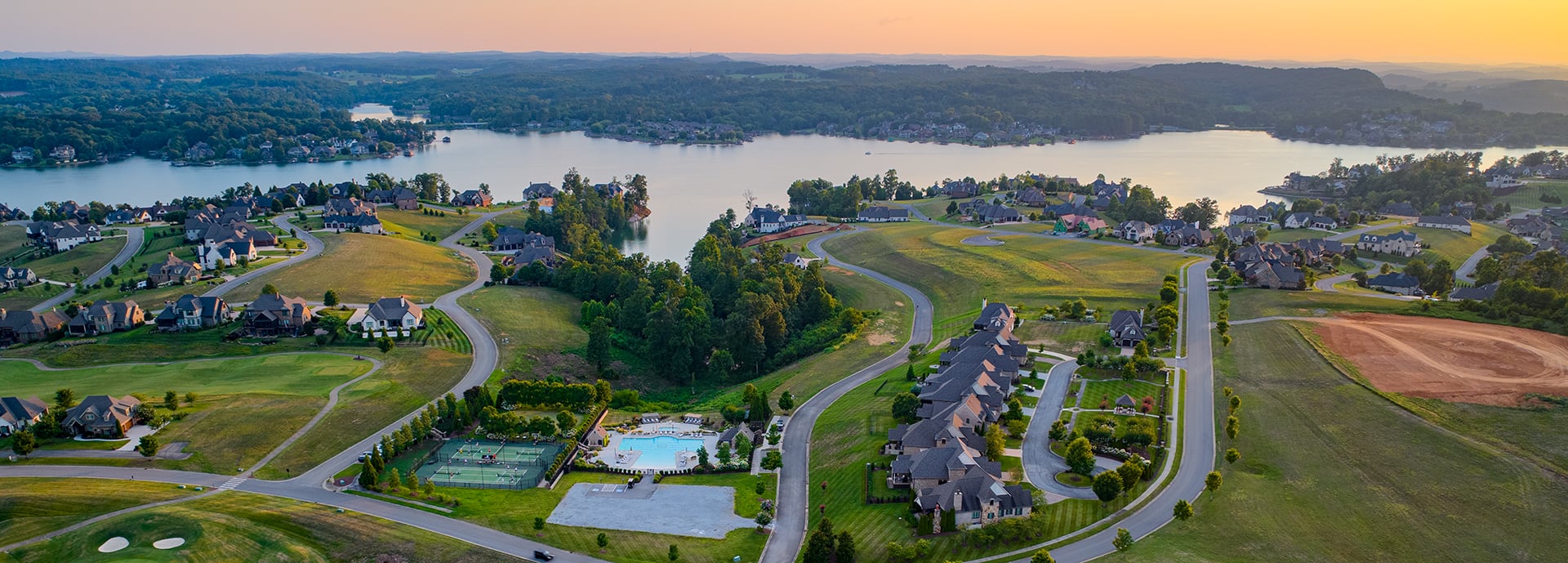
For Michigan residents considering the move south, WindRiver is a gated lakefront and golf community on Tellico Lake in Lenoir City, Tennessee. The community features a championship golf course designed by Bob Cupp and certified as Tennessee’s first Audubon Signature Sanctuary, a full-service marina with covered slips from 30 to 90 feet, Citico’s lakefront restaurant, a pool and sports complex, over 30 miles of hiking trails, and a new Clubhouse Village under construction.
Keep reading
Related articles

Your move
See WindRiver for yourself
For a transparent look at the community’s fee structure, including membership dues and what’s included, see our detailed cost and membership guide. To compare WindRiver with other Tellico Lake communities, see our side-by-side guide.
or call 865-988-1864
A lakeside, master-planned community on Tellico Lake — championship golf, a full marina and 30 miles of trails, minutes from Knoxville.
Real Estate
© 2026 WindRiver Tennessee. All rights reserved.